


The Blue Doors of Sidi Bou Said
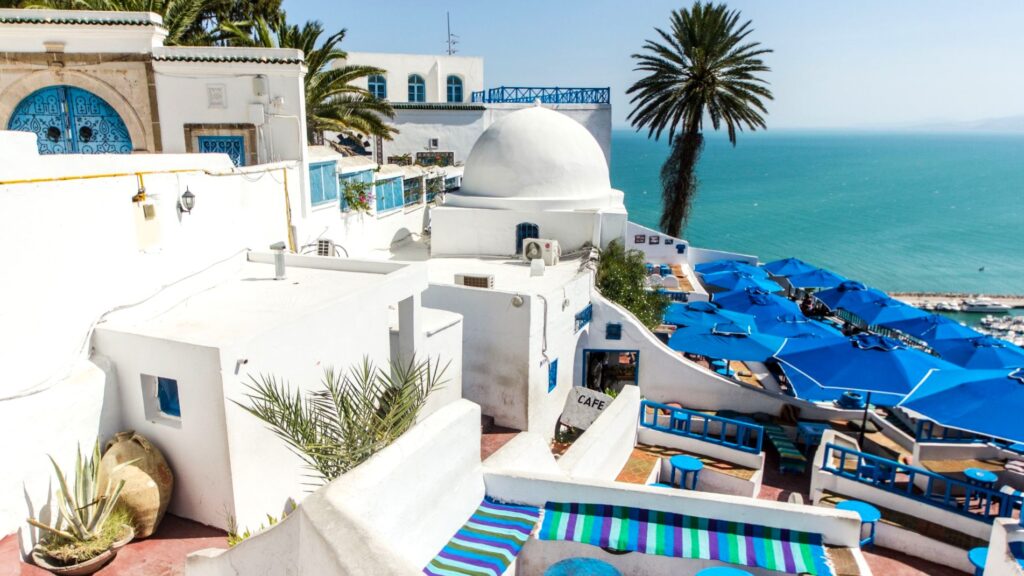
On a recent trip to Egypt to finally see Luxor and the great pyramids of Giza, we decided to make another stop in North Africa. It was late summer, and we still had a hankering for some beach time. We were also really curious about seeing Tunis and the ancient city of Carthage. Not on our radar when we planned the trip was the beautiful town of Sidi Bou Said. Known nowadays for its amazing tapestry of whitewashed buildings with contrasting ornate blue doors, the city has much more to offer than a really cool landscape, and it ended up being one of our favorite parts of our time in Tunisia.
Strategic Location
Set high on a hill overlooking Carthage, Sidi Bou Said boasts a rich history that blends religious significance, artistic influences, and of course, a really cool architectural identity. Originally named Jabal el-Menar, meaning “Mountain of the Lighthouse,” the area served as a strategic point for coastal defense during the 11th and 12th centuries. The Almoravids, a Berber Muslim dynasty, are credited with establishing a fort there.
As you walk through the town, which can be pretty vertical at times, the views of the valley below are stunning. As you approach many of the beautiful homes at the top of the hill, you get panoramic shots of the bay extending to the ruins of Carthage, which is really cool to see from that elevation.
Sufism and the Advent of Sidi Bou Said
In the 13th century, Abu Said ibn Khalaf Yahya al-Tamimi al-Beji, a religious figure and Sufi scholar, arrived in Jabal el-Menar. He established a sanctuary and dedicated his life to teaching and practicing Sufism, a mystical branch of Islam. After his death in 1231, a zaouia (a small religious complex) was built in his honor, and the town gradually came to be known as Sidi Bou Said, meaning “Lord Said.” Over the centuries, the town grew as a pilgrimage destination for those seeking blessings from Sidi Bou Said.
Wealthy citizens of Tunis were drawn to the town’s peaceful atmosphere and scenic location, leading to the construction of sumptuous villas in the 17th and 18th centuries. These residences, built in the Arab-Andalusian architectural style, are still a hallmark of the town’s distinctive character.
The Genius of Ornate Blue Doors
In the early 20th century, Sidi Bou Said became a haven for artists, writers, and intellectuals. The town’s beauty and tranquility attracted notable figures like Paul Klee, Gustave-Henri Jossot, August Macke, and Louis Moilliet, contributing to its artistic reputation. The town’s iconic blue and white color scheme is largely attributed to the influence of Baron Rodolphe d’Erlanger, a French painter and orientalist who lived in Sidi Bou Said from 1909 to 1932. He actively promoted the blue and white motif, believing it reflected the town’s purity and beauty.
The unique and aesthetic charm of the whitewashed buildings, with their stark blue doors, not only remains a defining aspect of Sidi Bou Said, but it’s lovely to walk from residence to residence and experience the different designs of each door. Deborah and I walked all over the town, checking out every type of blue door we could lay our eyes on. The architectural character of the homes in Sidi Bou Said is equally impressive, and it’s easy to see why Tunisians flock to this incredible town.