


Malaysia is Full of Wonderous Surprises
It’s unbelievable to me how Malaysia remains relatively unknown to many people I meet during my travels. I’m not talking about its incredible food scene, the endless islands with gorgeous beaches, or even the lovely demeanor of the Malaysian people. My surprise stems from the number of people throughout the Western world who don’t really know where Malaysia is located. What adds to my confusion is that most Westerners are familiar with the locations of Thailand and Singapore on a map, and mainland Malaysia literally sits right between them.
However, this is changing rapidly. Malaysia continues to be the “new” place for Westerners to discover in travel magazines, blogs, and among digital nomads. Whether it’s the tantalizing aromas of its world-renowned street food, the pristine beaches with a jungle backdrop, or vibrant international cities like Kuala Lumpur and George Town, where modern skyscrapers stand in harmonious contrast with historical architecture, Malaysia is full of unique and exciting experiences. Every time I visit a new area of Malaysia, I stumble upon another amazing, unexpected discovery—and the best part is, there’s always incredible food nearby.
Why Put Temples in Caves?
The geological landscape of Malaysia, particularly its abundance of limestone formations, has provided natural canvases for human spirituality for centuries. Caves, with their inherent mystique and sheltered interiors, became ideal sites for religious practices, leading to the development of unique Hindu and Buddhist cave temples across the country. These sacred spaces, carved and adapted within the earth’s embrace, are also used in other countries where Buddhism and Hinduism is prevalent.
While there is evidence of using caves for spiritual purposes dating back hundreds of years, the more prominent history of these temples largely unfolded in the late 19th and 20th centuries, coinciding with increased migration and settlement. Both Hindu and Buddhist communities sought out these natural wonders, transforming them into unique centers of worship and cultural expression.
The Majestic Batu Caves
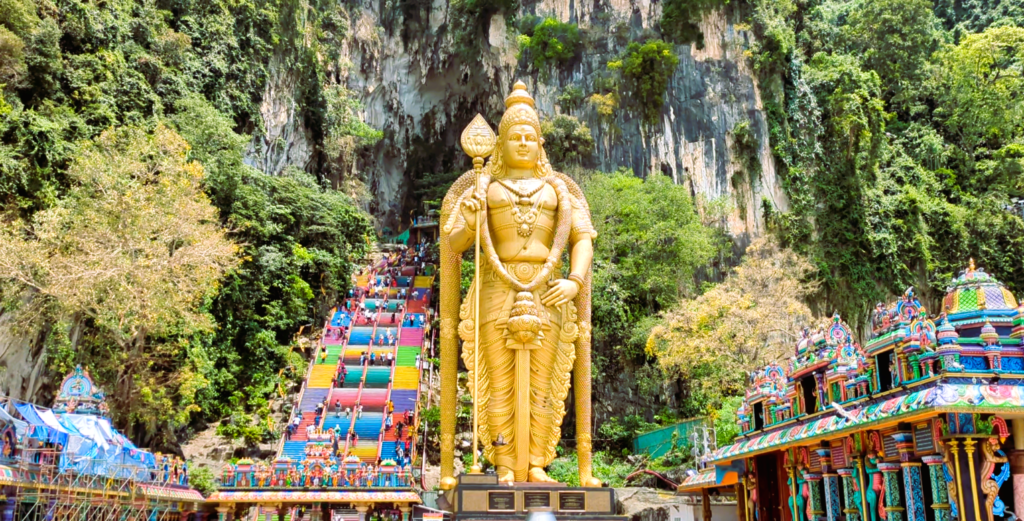
Perhaps the most iconic example of a Hindu cave temple in Malaysia is the Batu Caves, located in Gombak, just north of Kuala Lumpur. This impressive limestone hill, riddled with a network of caves, rose to prominence as a Hindu religious site in the late 19th century.
The American naturalist William Hornaday in 1878, who brought the caves to wider attention. However, it was K. Thamboosamy Pillai, a prominent Indian Tamil trader, who recognized the spiritual significance of the main cave’s entrance, its shape reminiscent of the ‘vel’ (spear) of Lord Murugan. Inspired, he established a temple dedicated to Lord Murugan within what is now known as the Temple or Cathedral Cave.
By 1891, the first temple was completed, and the annual Thaipusam celebrations commenced in 1892. This festival, a vibrant display of devotion and penance, has since grown into a massive event, drawing hundreds of thousands of pilgrims annually to Batu Caves.
Over the years, the Batu Caves complex has expanded. In 1920, wooden steps were installed to ease the ascent to the Temple Cave, later replaced by the now-famous 272 colourful concrete steps in 1940. At the base of the hill, other caves like the Art Gallery Cave, Museum Cave, and the Ramayana Cave (featuring dioramas from the epic Ramayana) were developed, further enriching the site’s religious and cultural offerings. Dominating the entrance today is the colossal 43-meter high golden statue of Lord Murugan, one of the tallest of its kind in the world, unveiled in 2006.
Batu Caves stands not only as a significant Hindu pilgrimage site but also as a natural wonder, its ancient limestone formations, estimated to be over 400 million years old, providing a dramatic backdrop to the spiritual activities within.
The Serene Perak Caves:
Further north, near Ipoh in the state of Perak, lies another significant cave temple complex: the Perak Caves (Perak Tong). While perhaps less internationally renowned than Batu Caves, Perak Tong holds its own unique charm and historical significance, primarily as a Buddhist temple.
The Perak Cave Temple was established in 1926 by Chong Sen Yee, a Chinese Buddhist priest, and his wife, Choong Chan Yoke, who were drawn to the serene environment of the limestone cave. Over several decades, they and later their son, Chong Yin Chat, diligently developed the site into a beautiful temple adorned with colourful murals, statues of Buddha and other deities, and intricate calligraphy on the cave walls.
The main chamber of Perak Tong features a majestic 12-meter tall seated Buddha statue, flanked by guardian figures. The walls of the cave come alive with vibrant paintings depicting scenes from Buddhist scriptures and Chinese mythology. A notable feature is the staircase leading up through the cave to an opening on the side of the hill, culminating in pavilions that offer panoramic views of Ipoh and its surrounding landscape after a climb of over 450 steps.
Interestingly, while primarily Buddhist, Perak Tong also exhibits a degree of cultural syncretism, with some murals and artistic elements reflecting Taoist and even Hindu influences, showcasing the harmonious coexistence of different faiths in Malaysia.
Other Caves to Visit in Malaysia
Beyond the famous Batu and Perak Caves, Malaysia boasts a variety of other captivating Hindu and Buddhist cave temples, particularly in areas like Ipoh, Penang, and even within the broader Batu Caves complex itself. In Ipoh, for instance, you’ll find the Sam Poh Tong Temple, renowned as the largest cave temple in Malaysia. What makes Sam Poh Tong so appealing is not just its impressive array of meticulously handcrafted Buddha statues but also its serene environment, featuring an award-winning landscaped garden with a large koi pond and miniature islands inspired by China’s Huangshan mountains. Nearby, the Kek Look Tong Temple (Cave of Ultimate Bliss) offers another vast and magnificent setting, showcasing numerous Buddha statues and Chinese deities amidst natural limestone formations, and providing a tranquil escape.
Also within the Batu Caves area, though sometimes overshadowed by the main Murugan temple, is the Ramayana Cave. This underappreciated cavern is a vibrant and almost psychedelic experience, adorned with detailed murals, statues, and striking neon lights depicting scenes from the Hindu epic, the Ramayana. Visitors are greeted by a giant statue of Hanuman, the Hindu god of wisdom and strength, at the entrance. Exploring these lesser-known caves offers a more intimate and often less crowded encounter with Malaysia’s rich religious and natural heritage, providing unique insights into Hindu and Buddhist artistry and spirituality nestled within stunning geological formations.
A Shared Heritage
The Hindu and Buddhist cave temples of Malaysia, exemplified by the grandeur of Batu Caves and the serenity of Perak Tong, represent more than just places of worship. They are historical landmarks that reflect the migration patterns, religious devotion, and artistic expressions of the communities that shaped them. Carved into the natural landscape, these temples offer a unique spiritual experience, blending the awe-inspiring beauty of nature with the profound peace of religious sanctuary. They stand as enduring symbols of Malaysia’s rich cultural tapestry, inviting devotees and visitors alike to witness the echoes of faith within their ancient stone walls.
Batu Caves, a prominent limestone hill in Malaysia, boasts a history stretching back over 400 million years, its cavernous spaces sculpted by the erosive forces of rainwater on limestone. Initially shelters for the indigenous Temuan people, the caves later attracted Chinese settlers who mined guano for fertilizer in the 19th century. The site’s transformation into a significant Hindu religious center began with K. Thamboosamy Pillai’s recognition of its spiritual importance, leading to the establishment of a temple dedicated to Lord Murugan in 1891 and the initiation of the Thaipusam festival the following year. Today, Batu Caves stands as a vital Hindu pilgrimage site, particularly during Thaipusam, marked by the iconic 42.7-meter-tall golden statue of Lord Murugan and the 272 colorful steps leading to the main Cathedral Cave, which houses Hindu shrines. The complex also includes the Dark Caves, offering ecological and geological explorations, and the Ramayana Cave, depicting scenes from the Hindu epic. Additionally, the surrounding area has become a popular rock climbing destination.
Perak, on the other hand, is renowned for its numerous limestone hills that conceal a network of cave temples, blending natural beauty with cultural richness. Over time, these temples have been meticulously crafted within the caves, creating serene and spiritually significant spaces. One of the most notable is the Perak Cave Temple, nestled within Gunung Tasek, a beautiful Buddhist sanctuary. Other important cave temples include Sam Poh Tong and Kek Lok Tong, each offering unique architectural and devotional experiences. These Malaysian cave systems, including those in Perak, are ecologically significant, harboring unique flora and fauna adapted to cave environments, and hold archaeological importance, with discoveries of prehistoric human remains and artifacts. Cave tourism is a popular activity in Malaysia, drawing visitors interested in exploring these natural wonders and cultural treasures.
Just A Little Off The Beaten Path
As I mentioned at the beginning of this article, on of the great things about Malaysia, no matter where you are in the country, there is always an amazing restaurant or hawker stall close by. If you do get the chance to visit the Perak Cave in Ipoh, we have the perfect spot to stop to eat, just minutes from the historic site. Yuan Mun Restaurant, famous for their Hakka noodles with that authentic, old-school taste. Hakka noodles are a popular Indo-Chinese dish, featuring stir-fried noodles with vegetables and sometimes meat, flavored with soy sauce, chili sauce, and other spices. As one of many favorable locals reviews described the restaurant, Yuan Mun’s Hakka noodles flavor and texture are just right – perfectly balanced. A highlight for me was the blend of three different sauces, which came together beautifully to enhance the noodles’ taste. We thoroughly enjoyed our lunch there, and while the price of the food didn’t factor into our review, it only added to how unbelievable the experience was and how much we recommend making this stop part of your plan while visiting the Perak Cave.